A Virtual Convergence for Projects, Partners, Publications, Thoughts, News

& a little bit of self-indulgence


Word of the Day


Twittering Mel

    follow me on Twitter
    Showing posts with label Reactions and Reviews. Show all posts
    Showing posts with label Reactions and Reviews. Show all posts

    Tuesday, July 6, 2010

    REVIEW: Recovering the Self: A Journal of Hope and Healing (Vol.1, No. 1, Sept 2009)


    Editor: Ernest Dempsey
    Publisher:
    Loving Healing Press
    Publication Website: www.recoveringself.com
    Also available at Amazon.com**


    REVIE
    W
    by me

    Recovering the Self: A Journal of Hope and Healing is a new quarterly magazine-sized journal that concerns itself with wide-ranging issues within the realm of health and all of its incarnations, including personal growth, relationships and family, trauma recovery, living with disabilities, addictions of all sorts, veterans’ issues, and bereavement.

    In its first ambitious volume, published September 2009, the variety of its contents, depending on the “health” of your mood could exemplify the let’s-fit-as-much-in-as-possible-first-timer-syndrome or an all-inclusiveness that might be appreciated by those on the outside of many of the issue’s themes, or the perfect reading remedy for any health-related ADD or ADHD.

    In editor Ernest Dempsey’s introduction to the collection, he speaks to an uninformed, inexperienced reader, rather than a reader that has lived, shared, or stood by watching and feeling the all encompassing hope and healing theme.

    Big mistake.

    Even a pre-teen could tell you that “pain invades our lives in different guises—illness, trauma, bereavement, accident, crime, and all forms of physical and emotional injury. Littered with hackneyed phrases, such as “the precious gift of life”, “tender as a rose” (gag), “painful experiences” (duh), “recovery is…[fill in blank with obvious and overly simplistic words]”, “the shackles of stress”, and on, and on, and on – so much so, that I almost got sick just from reading it. It’s the sort of crap you expect from self-ordained, self-help gurus that end up in the bargain books pile faster than you can get through the drive-thru at McDonalds.


    Unfortunately, what could be a profound and far-reaching magazine that could appeal to poetry, fiction, nonfiction, and/or self-help reader, lacks insight – even from its Ph.D. authors. In the contents section, “Inspiration”, Dr. Barbara Sinor, a therapist and (self-???)* published author of four books, chooses to rely on the easy and obvious in her nonfiction essay that redeems itself by its sincerity and empathy. “You can learn to re-create your own reality,” she writes “by discovering…patterns…which [sic] were accepted I childhood.”

    The most informative, interesting, and well-written piece in the entire journal is “Sex, Gender, and Personality Disorders” by Sam Vaknin, who has authored 10 or such books on the subject. And of course this is the most interesting, because who doesn’t like hearing about really screwed up people when you’re looking for self-healing? Instant ego-boost!

    Unfortunately, Vaknin makes many assertions that although interesting, such as “Men…mature earlier, die earlier, are more susceptible to infections...cancer…dislexi[a]…and…suicide,” they lack any researchable reference, so we have to assume these are just the opinions of the author. And to be honest, I don’t know many people, especially women and even most men, who would agree that men mature earlier than women. But the big wow of the article for me was the enlightening fact that “the brain structures of homosexual sheep are different to those of straight sheep.” Don’t you love a good brain structure?

    It’s hard not to be hackneyed when talking about healing and hope, and that’s the challenge that every writer on this subject needs to overcome to reach its reader – unless they’re looking to speak to cliché-lovers-united, a group that may or may not exist, but with a tiny publication like this, probably wouldn’t find its way into their petal-soft hands in due time.

    I applaud Dempsey’s vision, as well as, Love Healing Press, Inc., Recovering the Self’s publisher, and I offer them hope that their work will travel the journey of self-help and recovery, because people interested in healing – from whatever malaise – could find great use of this periodical/journal/mish-mash of everything and anything, even movie reviews.

    I just wish it weren’t so, well, to protract the oh-so-familiar spirit of this well-meaning premier volume, run of the mill.


    *On further research, I found that the majority of Dr. Spinora's books were "published" by vanity-type publishing houses that include Modern History Press Books AND Loving Healing Press, which seem to be the same entity.

    ** In my endless link search, I found that this publications received 8 glowing reviews on Amazon.com. Makes ya think. Either I'm a total dumbass, snob missing the beauty between the lines, or they have a lot of friends or a well-placed advertising budget.

    Monday, October 19, 2009

    Calling All Purchase-Pricing Whining Winos

    THIS IS TOO BLUSH-WORTHY & BLOOMING NOT TO SHARE

    I have to confess. I am a serial e-news subscriber, and I'm not just talking left-wing/socialist political activism; there's also fashion, and more fashion, and more fashion, the bright side project, healthcare and patient advocacy, neuro and spinal chord injury news, human rights activism, IVIg news...

    and Daily Candy - best described in their carefully copywritten words - "a handpicked selection of all that's fun, fashionable, food related, and culturally stimulating in the city you’re fixated on (and all over the Web)."

    This sweet, daily (multi-daily depending on how many versions you subscribe to) e-newsletter often provides yet more proof why I should be and stay in Philadelphia - despite the fact that I'm alone (not a loner) with my neuro fisticuffed fracas and the rock, rolled, and ruffled ruckus of my internal knock-down-drag-out, organ head-bumping, quibbling spine, nervousy[sic!] nervous system.

    With the 1/2 exception of Seattle (I did have a 4-hour layover there and took a cab to the nearest place - a mall (whoopee)), I can testify of the existence of all the Daily Candy cities listed below, having lived in two of them, been an artist-in-residence in one of them, got allergy shots twice a year for 8 hours a day in another (hint - CSI: [FILL IN THE BLANK]).


    Pictured Above: hottie Adam Rodriguez AKA Eric Delko


    [Disclaimer: The following paragraph contains verbosely gigunda sentences. Read and breathe at your own risk.]
    Of course, if I could take my mainly east coast family with me, as well as my Philadelphia docs, neuro soul support mates, Tria's Three Cheese Panino, and somehow make my disability income stretch like Hubba Bubba Bubble Gum or that nostalgic 90's favorite, Bubble Tape, into a month-long, all bills covered, carpets vacuumed, all-inclusive (ehhh ummm....poolside drinks with umbrellas) fest...(big breath), I'd return to my former London digs or settle in San Fran...


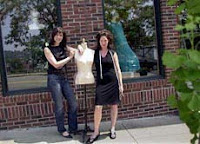
    ...Or, if I became a famous AND bequeathed, "enriched," and/or lavishly subsidized multi-talented visual artist and/or author and/or auteur, or simply a damn good creator of all things damn good, I'd take up residence in the lushly organic, gorgeous, mountainous Marin County (pictured left with pre-TM-me and friend standing at the top of a mountain that overlooks just about anything Marin) where incidentally my fashionista designer friend, Mary Margaret Stewart (pictured right on the right), owner of Iman B lives in bliss. Being close to her and her fabulous clothing line (of which I proudly own quite a few shirts and dresses) is reason enough to switch sides.


    Westward ho!
    (Or, perhaps that could mean that I'm a Westward ho)

    But location, location, location is important for all things non-virtual, and here is the virtual climax, the last swig, the forward finish, the big nose at the end of the lengthy Phylloxera...


    CHECK THIS OUT...(and gift it to....me?)

    The Accidental Wine Company.


    Need I say more?

    No. Because Daily Candy already has:

    "Every once in a while a mistake can lead to something awesome and brilliant (potato chips, LSD, penicillin).Add to the list The Accidental Wine Company."

    Sunday, March 9, 2008

    Scandal Scandalizing Scandal

    Kafka is dead!

    But today the New York Times published “A Bug’s Life. Really,” an Op-Ed spoof by novelist and screenwriter Mark Leyner, supposedly discrediting Franz Kafka’s novella “The Metamorphosis” as non-fiction.

    Fiction as truth, Oh my!

    The article begins, “In a scandal that’s sending shock waves through both the publishing industry and academia, the author Franz Kafka has been revealed to be a fraud.

    “‘The Metamorphosis — purported to be the fictional account of a man who turns into a large cockroach — is actually non-fiction,’ according to a statement released by Mr. Kafka’s editor, who spoke only on the condition that he be identified as E.”

    How literary it is to be simply called E.!

    What is Leyner trying to do? Demonstrate that the New York Times is a literary nightmare? That the recent scandals regarding fictional or historical or autobiographical integrity are McCarthy-esque witch hunts against an already marginalized and misunderstand profession? Offer his name into the coveted gated world of ping-pong-name-tossing-blaming-Oprah-interviewing-NY Times-covering-book store shelf space-rescinding publicity? Place himself at the zenith of literary genius, above the entire-museum-dedicated-to-his-work-and-life Kafka, the “con man” as he’s referred to Leyner’s article? To become a neologism, That Op-Ed piece was so Leyneresque! Wow, what a Leyneresque outfit! You are thus sentenced to 10 years imprisonment for this Leyneresque crime of treason. Don’t Bogart my Leynerism!?

    But the real scandal is in the positioning that fiction cannot be fact-based. Leyner has exposed what has long been recognized; most writers write from experience.

    There are numerous books on writing titled just that: “Writing from Experience”, by Richard A. Condon, “Writing from Experience” by Brian Taylor, “I Felt Like I Was from Another Planet : Writing from Personal Experience” by Norine Dresser, “A time in their lives;: Writings from personal experience” by Jerry Herman, “Writing from Experience, Revised Edition: With Grammar and Language Skills for ESL/EFL Students” by Marcella Frank, “Writing from Personal Experience: How to Turn Your Life into Salable Prose” by Nancy Kelton, “Writing from Experience: A Step by Step Approach to Freelance Writing” by Amanda Wilkins, “Talking and Writing from Experience” by Judith Atkinson and John Foster, “Writing Personal Poetry: Creating Poems from Your Life Experiences” by Sheila Bender, “Write from Life: Turning Your Personal Experiences into Compelling Stories” by Meg Files, and the list goes on and on and on and on.

    What is so new and disturbing about experience-based, or truth-based writing? At best, it makes for tangible, palpable, unparalleled, fully realized writing. At worst, it’s self-aware, self-indulgent, and predictable. But these categories could be extended to any kind of writing.

    In Leyner’s article, he quotes P., “a professor of literature at Princeton” who laments, “To find out that [“The Metamorphosis” is] actually true is devastating.”

    Devastating.

    And according to "A Bug's Life. Really," Mr. Kafka (despite his current state of burial) is devastated by this sudden exposure as well. He quotes a “contrite and tearful” Kafka as professing, “I know what I did was wrong. I’m very alienated from myself, but that’s no excuse to lie.”

    Lies.

    So we know Kafka is dead. Even if the Times doesn’t. Or maybe they were in on it. And according to Leyner, Kafka’s still living-breathing publishers are fact-checking his fiction. Fact-checking fiction, now there’s an oxymoron.

    In Leyner's article, he names the man-as-cockroach condition as “entomological dysplasia.” GoogleTM this, and one finds nothing but links back to Leyner’s article. (NOTE: When I began writing this, there was one page of results for "entomological dysplasia" in Google. A few hours later, there were two.)

    It doesn’t take a literary genius or a master of sci-fi to figure out that there’s no such condition and that Leyner’s article is no more truth-based than “The Metamorphosis.”

    Thanks to Leyner, the question of truth's significance in writing is yet again under consideration, but with a twist. He's taken the memoir verifiability debate to extreme. Let's just hope the literary police don't turn their radar to the gloriously unverifiable genres of fiction and poetry.

    Sunday, February 17, 2008

    Is Empathy Necessary?


    According to the very candid historian and author Inga Clendinnen, the "novelist's gift of empathetic imagination" is misleading.

    In her 70-page essay, The History Question: Who Owns the Past? (published in Quarterly Essay, Issue 23, 2006) she writes, "the 'insights' of empathy are untestable...Historical novelists spend time getting the material setting right, but then, misled by their confidence in their novelist's gift of empathetic imagination, they sometimes project back into that carefully constructed material setting contemporary assumptions and current obsessions."

    The question is, misleading to whom?

    Is it misleading to the author herself? to the reader? to the critic? to the egotistically-infringed academic? to the babysitter, the cat in the alley, the doorman, the barrista, the v.p. of marketing, et al?

    And, who cares?

    As I am reading a work of fiction, regardless of its origins, do or should I care if I’m being mislead? Only if what I’m reading is shallow and predictable, but then if it were, would I be mislead?

    Should the author care if she’s been mislead by her subject? Only if it results in bad writing, I presume.

    Should the barrista care if he’s been mislead? Ask the barrista. If he works at Starbucks, at least he has health insurance. Who can't empathize with that BASIC HUMAN RIGHT? (Note shifting pronoun throughout for sake of equality.)

    Being mislead is a personal choice, if not a preference. And those that don’t want to be mislead, should not be reading the newspaper, let alone a novel, or a memoir for that matter.

    Novel - a fictitious prose narrative of considerable length and complexity, portraying characters and usually presenting a sequential organization of action and scenes*

    But empathy is such a beautiful and relevant quality. We (as in myself and people I know...I dare not assume a universal we in this format) can not relate without it. Empathy is what allows us to move past judgment to compassion. And compassion is what drives us (ditto). While not all people are capable of empathy, whether due to mental or genetic disorders, it's what keeps my humanity busting out of its bones, and dare I presume, yours as well.

    Last night, I fortuitously watched The Hoax, a much lauded factual movie about a washed-up author (played by Richard Gere) who receives a million dollar contract to write the autobiography of the reclusive Texan billionaire, Howard Hughes. Only everything, including the verified letter of agreement from Hughes, is a hoax.

    A great premise for a movie, right? Historically based no less, right?

    But the characters. Oh, the characters. I could not, for the empathetic life of me, empathize with them. They were just too unlikable for me to become engaged, to care. And in their inability to evoke empathy from me, their experiences and actions became pigeonholed as…predictable.

    So, is the “novelist’s empathetic imagination” misleading?

    Probably, to a certain extent, if you’re a lawyer or the editor of HIPAA policies and procedures (which I have been the latter not the former), but one of the reasons for reading Philip Roth's fiction, Anne Waldman's poetry, Inga Clendinnen's accounts of history, People Magazine, or the Sunday funnies** is to exit
    one reality, that world of presumed innocence/guilt/right/wrong and enter into a new one. What really should be said, is that the writer's imagination is leading.

    The empathetic imagination is what leads us into the realm of the text - believable or unbelievable as it may inherently be.


    *novel. Dictionary.com. Dictionary.com Unabridged (v 1.1). Random House, Inc. http://dictionary.reference.com/browse/novel (accessed: February 16, 2008).

    **According to Wikipedia,
    the Reading Eagle boasts the "Biggest Comics Section in the Land".